
Sales & Closing
How to Win More Bids Without Being the Cheapest
Most bids are decided before anyone talks about money. Here is how to be first, how to write a proposal that sells the work, and what to say when the client says you are too expensive.
By the HandyBro team14 min read
The short answer
Contractors win more bids by fixing four things, none of which is price. Reply and quote faster than the competition, because the first credible number sets the standard. Send an itemized proposal with a written scope, exclusions, a schedule, and terms instead of a total. Offer two or three priced options so the client chooses between versions of your work rather than between you and someone cheaper. And follow up on a fixed cadence with new information each time.
The practical obstacle is that producing a proper proposal used to take an evening. Handy Bro removes that: describe the job, add the photos, and get an itemized estimate with labor at your rates and materials priced from live Home Depot and Lowe's data, ready to send as a branded proposal the client can approve on their phone — the same day they asked.
The four reasons bids get lost
Ask a contractor why they lost a job and the answer is almost always price. Ask the homeowner and you get a different story. They went with the person who came back first, or the one who explained things properly, or the one whose quote looked like it came from a company. Price decides fewer jobs than the industry believes, and it is usually the reason people give when the real reason is harder to articulate.
- 1
You were slow
The most common loss and the least discussed one. Clients rarely tell you they went with someone else because that person answered on Tuesday and you answered on Friday. They tell you the other quote was cheaper, because that is an easier thing to say. Whoever gets a credible price in front of a homeowner first sets the standard everyone else is measured against.
- 2
Your quote was a number, not a document
A text saying $6,800 forces the client to compare on price alone, because price is the only information you gave them. An itemized proposal with a scope, exclusions, a schedule, and terms gets compared on substance. The same number lands completely differently depending on what surrounds it.
- 3
They did not trust you yet
Trust is built in the small things: showing up when you said, knowing what you are looking at, explaining the problem in words they understand, having your license and insurance ready before they ask. Homeowners are afraid of hiring the wrong contractor far more than they are afraid of paying too much.
- 4
The price was framed badly
Not too high — framed badly. A total with no breakdown invites suspicion. A breakdown that shows where the money goes, what the alternatives cost, and what is excluded turns the conversation from whether the price is fair into which version they want.
All four are fixable without touching your rates. That is the whole argument of this article: the cheapest way to make more money is to convert more of the quotes you are already writing.
The visit is the interview
By the time you leave the property, most clients have already decided whether they want to work with you. The price only decides whether they can.
Arrive on time or call ahead if you cannot. Look at the whole thing before you say anything about money. Ask what prompted the project and what they are hoping for at the end of it, because the answer often reveals a different job than the one they described on the phone — someone asking about a bathroom vanity may really be worried about a smell they cannot locate.
Then explain what you see in language they can repeat to their spouse. Contractors underrate this badly. A client who can explain the problem to somebody else is a client who has bought into the solution. Point at the thing. Say what is wrong, what causes it, what happens if it is left, and what the options are. Say plainly when something is not worth doing — telling a client they do not need the expensive version is the fastest trust you will ever buy.
Two habits close the visit well. Confirm the scope out loud before you go, so you both leave with the same job in mind. And tell them exactly when the quote will arrive. Then send it early.
What a winning proposal contains
The document does more selling than anything you said in the driveway, because it is the thing that gets forwarded, compared, and read again at the kitchen table. Eight components, and the ones people skip are the ones that win jobs.
| Component | Why it wins work |
|---|---|
| A scope written for the client | Plain sentences describing what will be done, in the order it happens. If they cannot read it and picture the work, it is not finished. This is also the document that protects you when someone says they assumed painting was included. |
| Itemized labor and materials | Line by line, with quantities. Not so they can pick apart your margin, but so the number stops looking arbitrary. Clients who understand where the money goes argue about price far less. |
| An explicit exclusions list | What is not included: permits, disposal, painting after the repair, moving furniture, unknown conditions behind walls. Every dispute later begins with something that was never on either list. |
| Allowances for client-selected items | Tile, fixtures, and finishes they have not chosen yet get a stated allowance, with a note that the price adjusts against the actual selection. This is how you quote before they have decided anything. |
| Schedule and duration | A start window, working days, and what has to happen before you can begin. Clients rank availability nearly as highly as price, and a stated schedule is a reason to say yes now. |
| Payment terms and change-order policy | Deposit, progress payments, final payment, accepted methods, and a sentence saying that changes to scope get priced in writing before the work happens. Setting this out in the proposal prevents the awkward conversation mid-job. |
| Proof and paperwork | License number, insurance, warranty on your workmanship, and two or three photos of similar jobs. It costs nothing and answers the question they are too polite to ask. |
| A single obvious way to say yes | An approve button, a signature line, one clear next step and a date the price holds until. A proposal that ends without an action gets filed and forgotten. |
Put your logo on it and keep the formatting consistent job to job. A homeowner comparing three quotes is trying to guess which contractor runs an organized business, and the only evidence in front of them is the paperwork. A tidy document is not a cosmetic detail; it is the sample of your work that they can actually judge.
Give three prices, not one
A single price is a yes-or-no question, and a nervous homeowner answers those with “let me think about it.” Three options turn it into a choice among versions of your work, which is a much easier decision and one where you win every branch.
The essential version
The work that solves the actual problem and nothing else. Repair rather than replace where that is legitimate, the client's own materials, the shortest defensible scope.
Gives price-driven clients somewhere to land that is still your work at your standard, rather than sending them to the cheapest bidder in town.
The recommended version
What you would do in your own house: the right materials, the adjacent work that should be done while the wall is open, a sensible warranty.
Most people choose the middle, especially when the middle is explained as the one you would pick. This is the option your margin should be built around.
The complete version
The recommended scope plus the upgrades and the extras — better finishes, the second room, the thing they mentioned wanting eventually.
Some clients genuinely want it, and everyone else uses it to feel good about the middle option. Never present it as a sales trick; price it honestly so you would happily do it.
Two cautions. Every option must be work you would genuinely stand behind — inflating a top tier to flatter the middle is obvious to more people than you think. And do not offer options on everything; a leaking shutoff valve is a repair, not a menu. Tiers belong on projects where scope is genuinely elastic: remodels, exteriors, flooring, anything where “while you are here” is a real conversation.
How to present the number
Send the proposal, then talk about it. A number that arrives with no human attached gets evaluated by whoever in the household is most price-sensitive, with no one there to explain it. A two-minute call or a short voice note walking through the scope changes the odds considerably.
Lead with the work, not the total. Describe what you are going to do, mention the two or three things that drive the cost, then give the number and stop talking. The silence after a price is uncomfortable and contractors fill it by discounting themselves before the client has said a word. Let them respond first.
Never apologize for the price and never explain it as though it needs a defence. “It comes to $8,400, and that includes the disposal and the permit” is confident. “I know it seems like a lot, but...” tells the client the number is negotiable and that you are not sure it is fair. If you discount, take something out in exchange — scope for money, always — so your price keeps meaning something.
Answers to the five objections you always hear
None of these need a script memorized word for word. They need a settled position, so you are not inventing an answer while standing in someone's hallway.
- “That is more than I expected.”
- Do not defend the number and do not immediately discount. Ask what they had in mind, then show what fits that figure. Something like: “I hear you — let me show you what changes at that budget.” Then walk them through the essential option honestly, including what they give up. Either you find a version that works or they discover their expectation was not real. Both are better outcomes than a discount that comes out of your margin.
- “Another contractor quoted much less.”
- Ask to see it, without any edge in your voice. Nine times out of ten the scopes are different: no disposal, no permit, a thinner material, the electrical left to somebody else, or a lump sum with nothing itemized. Walk the two documents side by side and let the difference speak. If the scopes truly match and they are genuinely cheaper, say so plainly and let the client choose. Talking someone into a higher price they resent is how you get a difficult job.
- “Can you do it for cash?”
- Keep this simple and consistent: everything goes through the books, and the price is the price. You can offer a legitimate reason to pay promptly — a small discount for payment on completion, for example — but discounts tied to skipping paperwork put your license, your insurance, and your warranty in a place you do not want them. Clients who push hard on this are often the same ones who dispute the invoice later.
- “Let me think about it.”
- This usually means one specific thing is unresolved, and your job is to find out what. “Of course — is it the price, the timing, or something in the scope you are not sure about?” gives them three easy doors. If it is timing, offer to hold a slot. If it is scope, revise it while you are standing there. Then agree an actual next step: “I will check in Thursday” is a plan; “let me know” is a dead lead.
- “We are getting a few more quotes.”
- Encourage it, then arm them. “Good — you should. When you compare, check whether disposal and permits are included, whether the materials are the same grade, and whether the price is itemized or one lump sum.” You are handing them a checklist that your proposal passes and a lump-sum text message does not. Ask when they expect to decide, and put that date in your calendar.
The pattern in all five: ask a question before you make a statement. Objections are usually a request for information wearing a complaint's clothes, and the contractor who asks one calm question wins jobs the one who argues does not.
A follow-up cadence that is not nagging
An enormous share of quotes are never followed up even once, which is a strange thing to be true of a business that just spent hours producing them. The reason is that following up feels like begging. It stops feeling that way when every message carries something new.
| When | What to send |
|---|---|
| Same day the quote goes out | A short message confirming it was sent and offering to walk through anything unclear. Two sentences. This is the message that makes the proposal feel handed over rather than emailed into a void. |
| Day 2 or 3 | Ask a question rather than repeating yourself: whether they had any thoughts on the material choice, or whether the start window works. A question earns a reply; “just following up” does not. |
| Day 7 | Add information. A photo of a similar job you just finished, a note that the material they were considering went up, or a scheduling update. Give them a reason for the message to exist. |
| Day 14 | Address the calendar honestly: your next opening is such-and-such date, and holding it needs a decision by roughly then. Real scarcity only — inventing urgency you do not have is obvious and it costs you the job. |
| Day 30 | The closing message. “I am going to stop chasing this one so I am not a nuisance — if the project comes back around, call me and I will re-price it.” A surprising number of jobs are won by that exact message, because it arrives right when the cheap contractor has stopped answering. |
| Quarterly after that | Move them onto the long list. A short seasonal message twice a year keeps you in mind for the project they postponed, and postponed projects come back constantly. |
Match the channel to the client. People who texted you want texts; people who emailed want email; older clients often prefer a call. And keep the messages short enough to read on a phone screen while standing up, because that is where they will be read.
How Handy Bro helps you win the bid
Everything above assumes you can produce a professional, itemized proposal quickly. For a small operation that is exactly the constraint — the will is there, the free evening is not. Handy Bro exists to remove that constraint, on iPhone and Android.
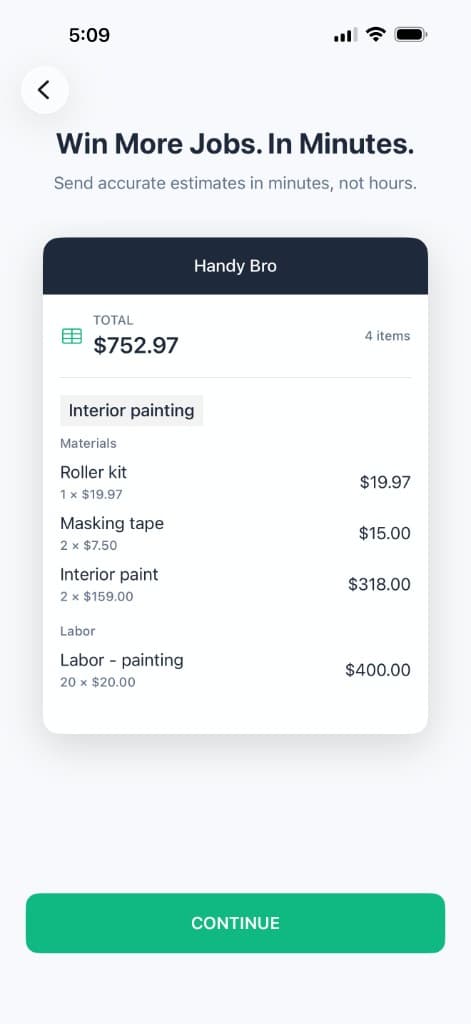
An itemized quote before you leave the driveway
Describe the job by typing or voice, attach photos, and answer the AI's clarifying questions. You get labor and materials broken out task by task, with quantities — the document that beats a lump-sum text message.
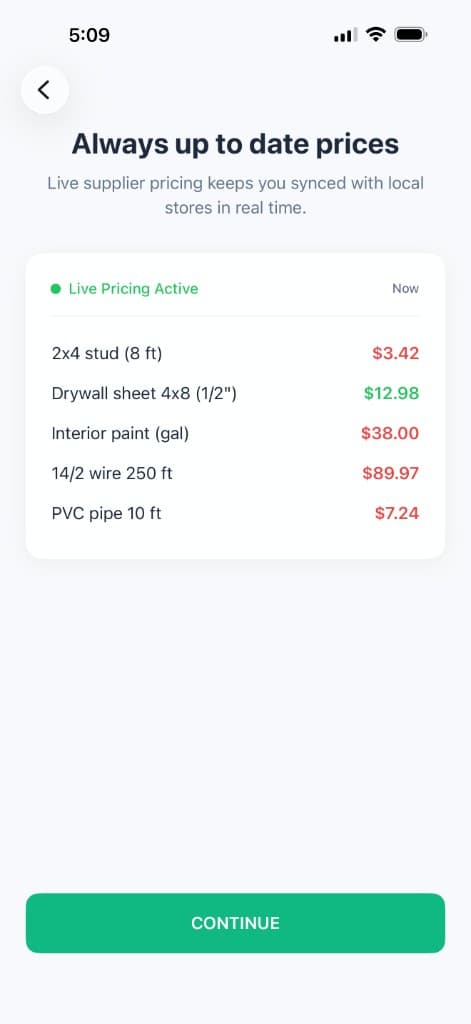
Prices you can defend line by line
Materials come from live Home Depot and Lowe's data and labor from your own rates, so when a client asks why a line costs what it costs, you have an answer. Duplicate an estimate and trim it to build your essential and complete options.
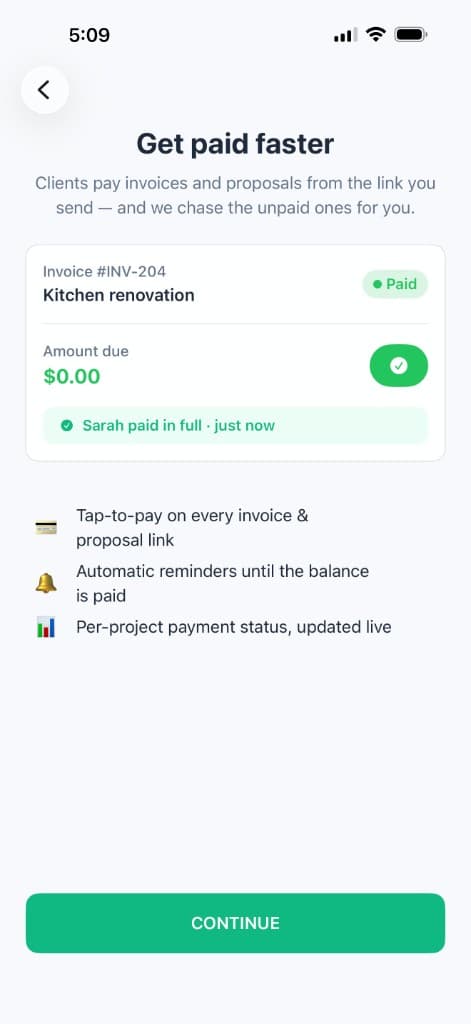
One obvious way to say yes
The proposal goes out branded, with an approve button the client taps on their phone. Approved work becomes an invoice they pay by card, so the moment of agreement and the moment of payment stop being two separate chases.
The compounding effect is worth stating plainly. If you currently quote three days after the visit and you start quoting the same day, nothing about your pricing or your skill changed — but you moved from being the second or third number the client saw to being the first, on every job, for the rest of the year.
Measuring and diagnosing your win rate
You cannot improve what you do not count, and almost nobody counts this. Track four things per quote: the lead source, the date you quoted, the amount, and the outcome. That is enough to answer the questions that matter.
Then read the pattern. If you win most referrals but almost no cold leads, your sales process is fine and your problem is trust with strangers — invest in reviews, photos, and proof. If you lose across the board on jobs above a certain size, that is a confidence problem: you are pricing bigger work at a level you do not fully believe in, and it shows in how you present it. If clients keep saying yes immediately without a flicker, you are underpriced and you are working too hard for it.
Change one variable at a time. Spend a month quoting within twenty-four hours and nothing else. Then a month adding tiered options. Then a month running the follow-up cadence. Otherwise you will improve and never learn what did it, which is how contractors end up keeping the expensive habits and dropping the free ones.
Frequently asked questions
- How do I win more construction bids?
- Attack four things in order: respond faster, quote with an itemized document rather than a number, present two or three priced options instead of one, and follow up on a set cadence. Speed and format usually move the win rate more than price does, because most clients are choosing between contractors who all feel roughly comparable and are defaulting to whoever made the decision easiest. Track your win rate before and after so you know which change actually worked.
- What is a good win rate for a contractor?
- It depends almost entirely on lead source. Referrals and repeat clients should close at a very high rate — if they do not, the problem is your pricing or your proposal, not your sales skill. Cold marketplace leads close far lower because you are one of several. Rather than chasing an industry benchmark, track your own rate per source for ninety days and improve it from there. A rate that is suspiciously high can also mean you are underpriced.
- How fast should I send a quote after a site visit?
- Within twenty-four hours, and same-day is better. The client's memory of you fades quickly and the competing quotes are arriving in the meantime. If the job needs supplier pricing you cannot get immediately, send a message on the day that confirms the scope you discussed and states exactly when the price will arrive, then hit that time. Reliability on a small promise is how clients predict reliability on a big one.
- Should I show a price breakdown or just a total?
- Show a breakdown. The worry that clients will use it to nickel and dime you is mostly unfounded, and the alternative is worse: a lump sum leaves them nothing to compare except your number against someone else's. A breakdown shows where the money goes, makes your scope visibly larger than a cheaper bid, and lets a client remove a line rather than reject the whole quote. Show quantities and line totals; you do not have to show your markup.
- How do I respond when a client says I am too expensive?
- Ask what they expected, then show what that budget actually buys instead of defending your number or dropping it. Most of the time the gap is scope, not greed — the cheaper quote excluded disposal, permits, prep, or used a thinner material. Walk both documents through side by side. If you genuinely cannot reach their number without cutting something you would not stand behind, say so politely and leave the door open. Jobs won on a resented discount tend to go badly.
- How many times should I follow up on an estimate?
- Five touches over thirty days is a reasonable ceiling: same day, day two or three, day seven, day fourteen, and a closing message at day thirty. Each one should carry new information or a genuine question, because “just checking in” trains people to ignore you. After thirty days, move them to a quarterly list rather than dropping them entirely, since postponed projects frequently come back six months later.
- Do priced options really help close jobs?
- They change the question from yes-or-no to which-one, and that is a much easier question for a homeowner to answer. Three tiers also give a price-sensitive client somewhere to land that is still your work, instead of sending them to whoever bid lowest. The rule is honesty: every option has to be work you would happily do, priced properly. Padding a top tier to make the middle look reasonable is transparent and it backfires.
- How can an app help me win more bids?
- By removing the delay and the paperwork gap. Handy Bro turns a job description and photos into an itemized estimate with labor at your rates and materials priced from live Home Depot and Lowe's data, then sends it as a branded proposal the client approves online. You can build alternate versions of the same job for tiered pricing, and the whole thing happens on your phone, so the quote goes out from the driveway rather than after dinner three days later.
- Should I charge for estimates?
- Charge for the ones that consume real work. A quick look at a straightforward job can stay free, but a detailed scope for a complex remodel, a diagnostic call, or a long drive deserves a fee — often credited toward the job if they hire you. Charging filters out people collecting free consulting and signals that your time has value. Be upfront about it in the first conversation, never as a surprise on arrival.
- What should I do about bids I lose?
- Ask, once, without any defensiveness: “No problem at all — do you mind telling me what made the difference? It genuinely helps me.” Roughly a third of people answer honestly, and their answers are the most useful business data you will get all year. Log the reason in one line next to the quote. Patterns show up fast, and they are usually about speed or clarity rather than price.
The bottom line
Winning bids is not about being cheaper or being a better talker. It is about being easy to choose: first with a number, clear about what you will do, honest about what you will not, and reliable enough that the client can predict the whole job from how you handled the quote.
Pick the one change with the highest ratio of effect to effort and do it this week. For most contractors that is quoting the same day instead of the same week. Everything else — the tiers, the objection answers, the cadence — builds on top of already being the first credible number on the kitchen table.